
October 6, 2026
Cost before price: the order that makes a yes make sense

The order you say things in on a sales call decides how your price sounds.
You know the moment. You say the number. Then nothing. The potential client looks down, or away, or says "hmm." And you start talking to fill the quiet.
That silence is supposed to be there. They are thinking. The mistake is talking through it, and the urge to talk gets strongest when the number arrived before the reason for it.
Why the silence happens
A price is a number with nothing next to it until you give it company.
When the call opens on your packages, your process, and your credentials, the potential client spends the whole conversation hearing about you. Then the price lands, and the only thing it can be compared to is their bank balance.
When the call opens on their situation, the price has something else to sit beside. What this problem has already cost them.
Price and cost are two different numbers
- Price is what they pay you. You set it. It lives on your pricing page.
- Cost is what the problem is taking from them right now. It belongs to them. It lives in their calendar, their revenue, their energy, and their reputation.
Price is a one-time decision. Cost keeps running every week the problem stays.
A potential client who has said the cost out loud, in their own words, hears your price as a comparison. One who has not hears it as an expense.
The four cost questions
Ask these before any offer is on the table. Listen for the substance of the answer more than the wording.
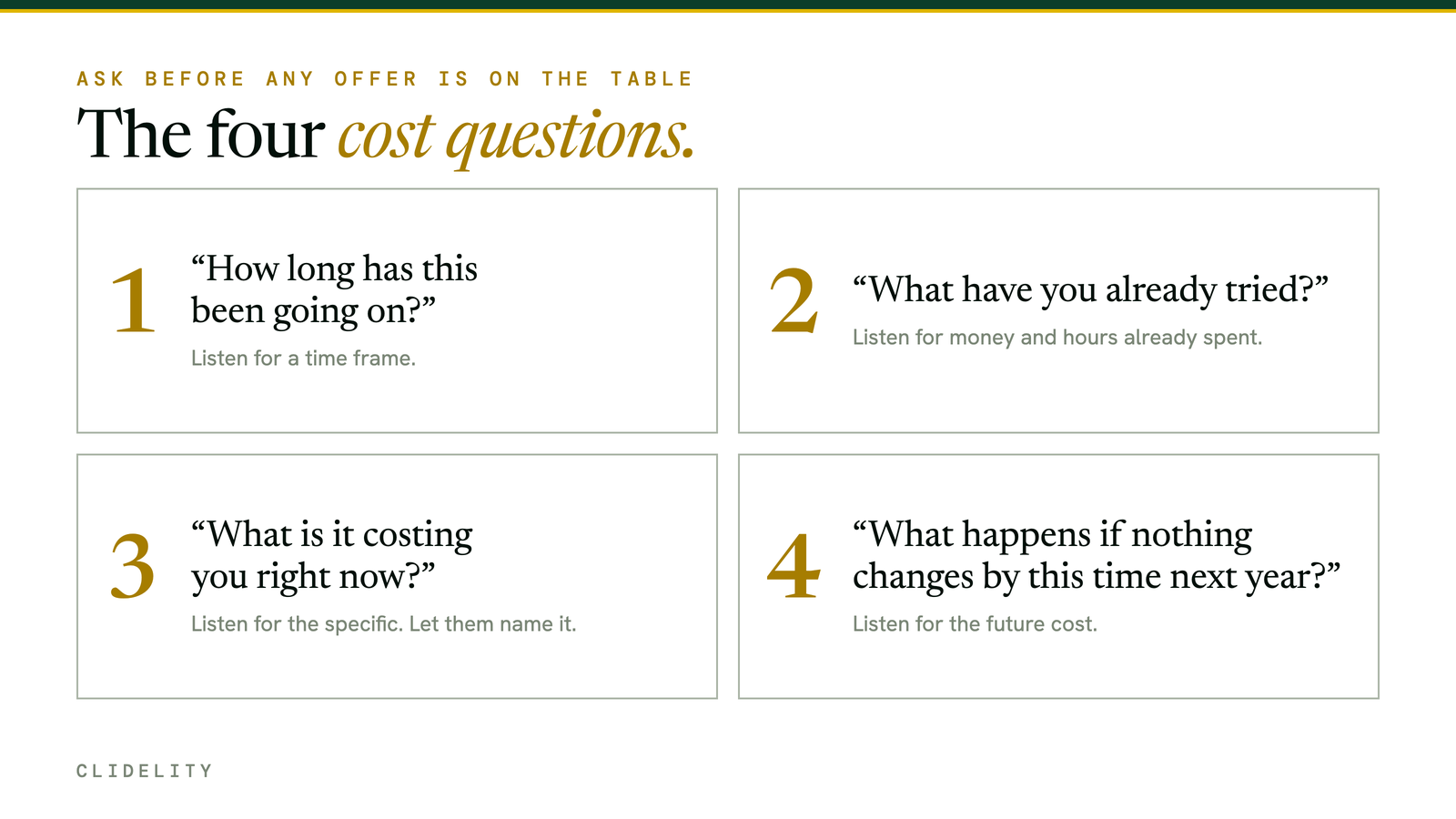
- "How long has this been going on?" Listen for a time frame. Months and years tell you the problem is old, and so are the workarounds.
- "What have you already tried?" Listen for money and hours already spent. Courses, tools, contractors, weekends. That is cost they have already paid.
- "What is it costing you right now?" Listen for the specific. Lost clients, a delayed launch, a team member doing the wrong work, a reputation they are nervous about. Let them name it. Do not name it for them.
- "What happens if nothing changes by this time next year?" Listen for the future cost. This is often the moment the call gets quiet in a useful way.
Write it down in their words
Take notes in their language. If they say "I keep dropping the ball on follow-ups," write exactly that. Do not translate it into "lead nurture gaps."
Three reasons:
- When you reflect it back later, they recognize it as theirs.
- It keeps you honest about what they actually said versus what you assumed.
- It becomes the bridge to your price.
Where it goes in the call: right before the plan. Read their words back to them.
"You said [their words]. You said it has been going on for [their time frame]. You said it has cost you [their cost]."
If they did not say something, leave the blank. "They did not mention a number" is useful information. A guess is only a guess.
Three mistakes that make a price sound expensive
- Naming the price early. Someone asks "how much" four minutes in. You answer. Now every minute after is spent defending a number. Try this instead: "Happy to share that. I want to make sure I recommend the right thing first. Can I ask a few questions?"
- Discounting before an objection. You say the number and immediately add "but I can do a payment plan" or "I could take something off." Nobody asked. You just told them the price was negotiable before they had a chance to consider it.
- Filling the silence. Silence after a price means someone is thinking. Let them think. Count to five in your head if you have to. Whatever you say next will come from your nerves, and their decision needs the quiet.
How The Closing Framework orders the call
The Closing Framework puts cost before price by design. Four stages, in order:
- Intake. What they told you before the call, in their words.
- Assessment. The cost questions. Diagnose before you prescribe.
- Plan. What you recommend, tied back to the cost they named.
- Decision. The price, and a clear yes or no.
I spent fourteen years in case management before coaching. That work runs on the same order. You understand the situation fully before you recommend anything, and you write down what the person told you, the way they told you.
Where Clidelity comes in
The hard part is not knowing the order. It is doing the prep before every call when your week is already full.
Clidelity turns a potential client's intake into a closing strategy for the sales call, written in your own voice. It pulls their words forward, so you walk in already knowing what they said the problem is costing them.
When the intake did not say something, your closing strategy says "not stated" instead of guessing. You never walk into a call quoting something they did not say.
After the yes, Clidelity builds the kickoff plan too.
What that gives back:
- Time. The prep is done before you sit down.
- Money. Calls that used to stall at the price now have a reason to keep going.
- Reputation. Every word you reflect back is one they actually said.
Conclusion
A potential client deserves care, consideration, and a real strategy built on proper analysis before they ever hear a number. Ask about the cost, write it down in their words, say it back, then quote the price and let them think.
Which of the four cost questions do you skip most often?
Kalilah Hudson is the founder of Clidelity and K. Hud Branding Studio. She spent fourteen years in case management before building systems for coaches and consultants.